Showing posts with label puzzled. Show all posts

Thursday, May 31, 2012

Non-sequitor for the day

Report here:

Warwickshire's chief fire officer, Graeme Smith, had condemned the decision to press criminal charges against the three senior officers who he said had been "treated like common criminals".

But Det Sup Ken Lawrence, who led the Warwickshire Police investigation, defended the case.

He said: "We have a legal duty to investigate every death in whatever circumstances.

...

"So I would pose that question, how can anyone suggest that that doesn't warrant an investigation?"

And I would pose a question. How does a duty to investigate mean that criminal charges must be brought? Answer, in the box-ticking targets driven, "every incidence must result in a sanctioned offence" world of modern anti-Peelian policing.

It is a tragedy that the four fire-fighters died. But, let's be honest - like being in the Services, being a deep-sea fisherman or, admittedly to my surprise, a window cleaner, you know it is a dangerous job when you take it on.

Wednesday, May 23, 2012

Beecroft and the Bleeding Obvious

Just sayin'.

Okay, he's pretty senior in their commune, so you couldn't just give him DFID. But couldn't he have been put in some position less obviously affected by his Maoist outlook? Health, maybe. Treasury Secretary?

Saturday, March 31, 2012

Mind boggling

For various reasons (okay, well, organisational penury), I've been haunting the pages of Ebay, mostly buying up bits of kit for work. Firewalls I don't know how to program, packetshapers I know go wrong regularly, that sort of thing.

But I've been amazed at the prices people are willing to pay for some stuff - more than it costs new, in many cases.

But I've just be staggered to see a 1oz palladium coin on sale for about £15,000. I had no idea what palladium was worth (although I did know it was on the pricey side) but Google is my friend and you can buy a 1oz ingot online for about $670, so on the order of £400. So that's, what, roughly 40 times the bullion value. For a not very attractive picture.

But is this a low issue coin thing? Well, okay, maybe. So I checked on the Royal Mint site. You've got the Queen's Diamond Jubilee platinum £5 coin - 94g of platinum for £6,400. Now platinum is about $1630 a troy ounce at the moment (slightly cheaper than gold, which surprised me - but the world has changed since I last worried about precious metal prices) - which works out, for a commemorative coin of only 250 issued, at a mark up of about 110%. Which seems rather more sensible. And you do get a nice box to keep it in.

Wednesday, March 10, 2010

Newton's Laws

Dear Billy,

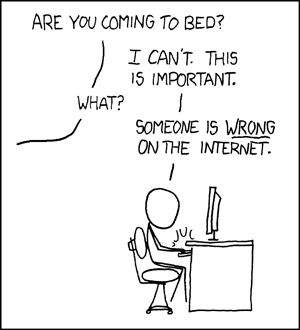
(Cartoon is a classic from xkcd.)


I have addressed your points - Everything you say is against Newtons Laws - an aluminium plane cannot do what you are claiming.

All videos of 911 show the planes melt into the buildings, with the builings sealing themselves up after the plane has entered, then exploding inside after coming to a sudden halt, then the building is supposed to have weakened and collapsed because of the fires from the plane fuel which burns at 816 Degrees Cent (in an enclosed space even though you see the fuel burn up in seconds on the videos) when in fact steel melts at 1482 Degrees Cent.

in lieu of a longer post, which will have to wait until I finish work today, I am posting "Newton's Laws" - I assume you meant 'Newton's Laws of Motion" - I can't see what gravity, cooling or viscosity have to do with this.) Which of these states that an aluminium (they're not, really, but it probably doesn't make that much difference) aircraft will bounce off (or be completely stopped outside of) a modern building?

1.  Law of Inertia. Every body persists in its state of being at rest or of moving uniformly straight forward, except insofar as it is compelled to change its state by force impressed.
2. The change of momentum of a body is proportional to the impulse impressed on the body, and happens along the straight line on which that impulse is impressed.
3. Law of Reciprocal Action: To every action there is always opposed an equal reaction: or the mutual actions of two bodies upon each other are always equal, and directed to contrary parts.

Now, when a Boeing 767 hits the glass and concrete facade of a steel-frame building, it will slow down. Rapidly. At 300knots there is nearly 20 million N.s involved in that impact. Moving at roughly 150 m/s, and at under 50m long, you are going to get a lot of force.  Basically, Law 1 says that, unless you have a force, the plane will keep on moving.  That force comes, mostly, from the structural materials of the building.  Law 2 allows you to calculate or estimate the forces involved and you then start to have to worry about sheer and other stresses (oh, and the integrity of welds and effects of corrosion and all sorts of clever materials effects).  Law 3 says that the necessary force on the plane is matched by an equal and opposite force on the building.  Please note here that you maintain that the plane(s) could not have gone in to the building- that they would have been stopped by the concrete surrounds of the windows.

Glass and the thin concrete in the facade simply do not have the shear toughness to take this and crack or crumble, failing to provide enough force to stop the plane,  which carries on into the building. Slowing down quite rapidly and falling apart (because aircraft aren't tough enough to take this sort of thing either) - although some of the bits, especially the engines, will keep going for longer being both more dense and more sturdy. At some point (not many seconds later), a large plane, like a 767, will hit the frame and either shatter that (causing a fairly immediate collapse) or come (mostly) to rest. A light plane (Piper Dakota, for example) will wear off its velocity against other objects - desks, computers, people, filing cabinets, whatever - and may not reach the main frame - especially if the floors are quite strong.

I will note here that as kinetic energy is proportional to the square of the velocity and momentum only linearly, then there will now be a lot of "spare" energy about.  Under the first law of thermodynamics, this can't just wander off and go for a coffee, so has to hang around.  Most of it will be as heat energy.  Which will have a bad effect on all of the fuel now inside the building ...

A slightly heavier (than the Piper) but much less tough (either then the Piper or a 767 - aerospace technology has improved dramatically since then) plane (a 10 tonne B-52 B-25 Liberator bomber, without bombs) hit the Empire State Building in 1945.    No direct energy weapons then.  Eye witness accounts, from inside the 79th floor, have the plane exploding inside the building ...

Monday, February 15, 2010

Surprised?

Shocked even? This, from the BBC:

More than half of those of both sexes questioned said there were some circumstances when a rape victim should accept responsibility for an attack.

Now, that just shows both how difficult the debate has become and the wider issues surrounding "one person's word against another's" crimes - domestic violence, for example. And women who have been raped are appalled by the survey results.

It (the BBC article, the report, the questions in the research for the report or the questioned) also misses the fundamental difference between 'responsibility' (or as the subsequent comments have it 'blame') and 'contributory behaviour'. I would like to demonstrate with two much less emotionally charged or controversial examples:
  • I accidentally forget to lock my car when parking it in a city centre car park. Somebody steals the car, or something from the car. They are a thief and are criminally responsible for their actions. My behaviour in parking the car in the city centre is neither (unreasonably) contributory nor responsible. My failure to lock the car is significantly contributory. This should make no difference to the criminal case but might reasonably change the amount, for example, that my insurance company would pay out.
  • I am dismissed from my job for some heinous offence against good taste (I have a number of ties that should do the job.) My tie-disaster is so extravagant evil that they fail to follow the corporate disciplinary policy and summarily dismiss me with immediate effect. I go to Tribunal. It is, because of the failure to follow policy, automatically unfair dismissal. In a heroic devotion to justice and truth, one of the lay members of the panel asks to see the tie. As they are rushed away to Intensive Care, the Chairman declares that my behaviour contributed 99% to my dismissal therefore my compensation will be minimal.
'Blame' for criminal acts, whether life-changingly drastic like rape or trivial, lies with the criminal (unless they do not have the capacity for mens rea in an offence that requires it - in which case they need to be in, or under, some form of care.)

Yes, there are defences of, or similar to, provocation (e.g. self-defence) and there are pleas of mitigation - only the former of these shifts (or removes) responsibility. And I fail to see, under modern British law, how 'provocation' can apply to sexual offences.

Edited to add: Having reread this post, after reading Bella's comment, I can see how my two examples (where the contributory factor is high) might lead people to think I am excusing rapists or blaming victims. If you get that impression - please reread the third and second-last paragraphs of the original article, where I clearly didn't make it clear the difference between responsibility / blame on one side and low risk versus high risk behaviour on the other. No-one 'deserves' to be raped. Equally, if less significantly, no-one 'deserves' to have their car stolen. Regardless of the seriousness of the offence, 'high risk behaviour' is no excuse for the criminal.

Sunday, February 14, 2010

Truth from the BBC? Never!

Yes:

Hamas is the Palestinian militant Islamist organisation that runs Gaza.

Only, it has to be said, because it's a journo that has been 'detained'. (Union) comradeship is thicker than ethics, perhaps?

Paul Martin is, of course, a freelancer for the BBC and has form locally.

Note: as a matter of simply feeling right about the world, not that that or any principle applies to journalists, I do hope that the Paul Martin who writes reasonably interesting articles about Palestine is a different Paul Martin to this one.

Wednesday, December 23, 2009

What is "Illegal"?

Disclaimer - this is the author's opinion on what the law is, not what the law should be ...

Amnesty International on the Uganda "Bahati" or "Round 'em, put 'em in a field ..." Bill:

"Certain provisions in this bill are illegal; they are also immoral," said Kate Sheill, Amnesty International's expert on sexual rights. "They criminalize a sector of society for being who they are, when what the government should be doing instead is protecting them from discrimination and abuse."


Okay - there is only one word in that that I disagree - obvious from the title - and that is "illegal". I happen to think that both the Bahati Bill and the current position in Ugandan law (under Section 140 of the Uganda Penal Code) is certainly arguably dodgy law under Articles 21(1) and 32(1) of the Ugandan Constitution, although readers will note that Article 21(2) of the Constitution expressly does not mention "sexual preference" and, in fact, Article 31(2a) explicitly discriminates against homosexuals - although no more than the UK or the USA (the latter federal) do - in denying 'marriage' - (Ed notes: he is trying hard not to do a Princess Bride / Peter Cook thing here ...) But I don't think that is Amnesty's point - I think they are talking about "International Human Rights Law", here:

The final section of the bill provides for Uganda to nullify any of its international or regional commitments that it deems "contradictory to the spirit and provisions enshrined in this Act." As both the African Commission and the UN Human Rights Committee have held, a state cannot, through its domestic law, negate its international human rights obligations.


But a state can withdraw from or otherwise abrogate those treaties it has freely entered into and anyway, a reasonably careful search of the UN doesn't actually show any treaty or covenant explicitly requiring equal treatment on the basis of sexual preference. Nope, not explicitly. You do have the International Covenant on Civil and Political Rights - to which Uganda is a State Party without reservation (since 21 June 1995). Now, Article 2(1) states (my bold):

1. Each State Party to the present Covenant undertakes to respect and to ensure to all individuals within its territory and subject to its jurisdiction the rights recognized in the present Covenant, without distinction of any kind, such as race, colour, sex, language, religion, political or other opinion, national or social origin, property, birth or other status.


Which you could read, for the States Parties, that they agree not to discriminate against people with the 'other status' of fancying or bonking people of their own sex. But this is not settled law - never mind that Article 23 of the Covenant itself seems to imply marriage being specifically between man & woman - the mere existence of the "UN Declaration on Sexual Orientation and Gender Identity" and the opposing Arab League sponsored declaration (with nearly as many signatories - 57 compared to 67) shows that, despite the completely non-binding Yogyakarta Principles.

There are aspects of the Bahati Bill, regardless of your opinion on the core issue of homosexual rights, that are utterly distasteful (and probably even more easily corallable as illegal under Uganda's Constitution or international obligations):

  • The death penalty. Although Uganda are not a signatory to the 2nd Optional Protocol to the Convenant, the Article 6(2) of the Convenant restricts the death penalty accordingly: "sentence of death may be imposed only for the most serious crimes". As s3(1)(b), just for example, of the Bill would impose the death penalty for consensual, protected homosexual acts for adults with HIV, I am fairly sure it would fall foul of this (whereas s3(1)(a) - homosexual paedophile acts might not?)
  • The restrictions on free speech.
  • The requirement (under penalty of prison) to inform on your friends, colleagues or mere acquaintances.
  • The explicit extension of the Stasi clause to ministers of religion with, at least as far as the Christian ones are concerned, the consequent violation of the sacrament of confession (thus possibly breaching the Article 18 rights on freedom of religion, although the qualification in 18(3) for morals is noted. And this is, fundamentally, an argument about opposing morals.)
So, I don't think the Bahati Bill would be "illegal". It might require amendment of the Ugandan constitution, it might (although I don't think it does) require Uganda to withdraw from some treaties currently binding it. Doesn't make it right, I know, but just saying ...

Saturday, December 12, 2009

I'm not sure this is right.

Mr Roger Day has been arrested, by Warwickshire Police, for an offence under s197 of the Army Act 1955, being that on the 8th November this year, he did march down Bedworth High Street wearing a bunch of medals to which he clearly was not entitled.

Some people are quite surprised by this. Some people think it is, or should be*, a reprehensible crime. I would quite like to see the stocks brought back and would be willing to travel to Bedworth and supply the local urchins with rotten fruit and out-of-date eggs.

Anyway, this deluded old fool (assuming he isn't a fraudster - in which case England has a perfectly good Fraud Act 2006 to wield) has done something objectionable (but no more so than playing rap music in public, for example), and has been arrested.

I bring to your notice Schedule 17 of the Armed Forces Act 2006 (Repeals and Revocations):
Army Act 1955 (3 & 4 Eliz. 2 c. 18) The whole Act.

The MOD announced, in a Defence Internal Brief that "The Armed Forces Act 2006 will come into force on 31 October 2009" - I assume there is another enabling Statutory Instrument (there were 4 already by the end of March 09). There is no equivalent of the s197 offence in the new act.

? Or maybe Warwickshire are operating in a little time warp?

* Disclaimer - I know Adam - for a very weak (aka internet) definition of "know".
 
HTTP Error 403: You are not authorised to access the file "\real_name_and_address.html" on this server.

(c) 'Surreptitious Evil' 2006 - 2017.